
Altoona City Directory Holdings
Altoona has a documented historical directory trail from the railroad city’s early decades. The surviving evidence is a set of verified rungs, not a promise of a book for every year. A federal HABS bibliography identifies the early publishers and later Polk runs, while the Altoona Area Public Library keeps old city directories among its local-history materials. Penn State University Libraries supplies a freely inspectable 1912–13 Polk book. Ask for a particular year rather than assuming a full sequence is on one shelf.
| Collection | Verified years | Holding route | Access |
|---|---|---|---|
| Early Altoona and Blair directories | 1870–71, 1873–74, 1878–79, 1880–81, 1882–83, and selected 1886–93 runs | HABS bibliography, then library or archive inquiry | Locate the needed physical or digital copy. |
| R. L. Polk Altoona directories | Begins 1896; cited later runs have gaps through 1939 | Altoona library historic holdings and research repositories | Year-specific volume access. |
| Polk Altoona and Hollidaysburg | 1912–13 | Penn State PA’s Past Digital Bookshelf | Browsable digitized volume. |
| Altoona library local-history materials | Old city directories; individual years not published in the research | PA Room and Digital Library | Online indexes plus in-person research. |
Gaps matter. A directory absence can mean an unissued or unlocated edition, an omitted person, a name variation, a move, coverage outside the volume, or a listing under another household head. It is not proof of a life event by itself.
Altoona Directory Publishers
Publisher changes are part of the research value. J. H. Lant’s Blair County Directory covers 1870–71. Thomas H. Greevy followed with an Altoona volume for 1873–74. William H. Renner, Webb Brothers, and C. B. Clark each appear in the documented run before R. L. Polk & Co. became the later publisher. A citation should name the volume and year, because the title and geographic scope can change from one publisher to the next.
- 1870–71: J. H. Lant’s Blair County Directory is identified in the HABS bibliography.
- 1873–74: Thomas H. Greevy’s Greevy’s Altoona City Directory appears in that bibliography.
- 1878–79 and 1882–83: William H. Renner directories provide two verified rungs.
- 1880–81: Webb Brothers published The Altoona Directory.
- 1886, 1888, 1890, 1891, and 1893: C. B. Clark directories are specifically cited.
- From 1896: R. L. Polk & Co. begins the later run, with cited editions through 1939 but not every year.
Altoona was laid out by the Pennsylvania Railroad in 1849 and grew around tracks and shops. That local story helps explain why street, ward, rail, and neighborhood references appear in historical sources. It does not turn a directory line into a complete record of an entire family.
Altoona City Directory Polk Volume
The digitized 1912–13 R. L. Polk & Co.’s Altoona and Hollidaysburg directory is a concrete example of how an Altoona city directory reads. Penn State identifies R. L. Polk & Co. of Pittsburgh as publisher. It is name based, with entries that commonly carry a surname and given name or initials, an occupation or activity, and a residence or address. The book also uses locality labels that require care.
The Penn State digitized 1912–13 Polk directory is available through PA’s Past Digital Bookshelf.
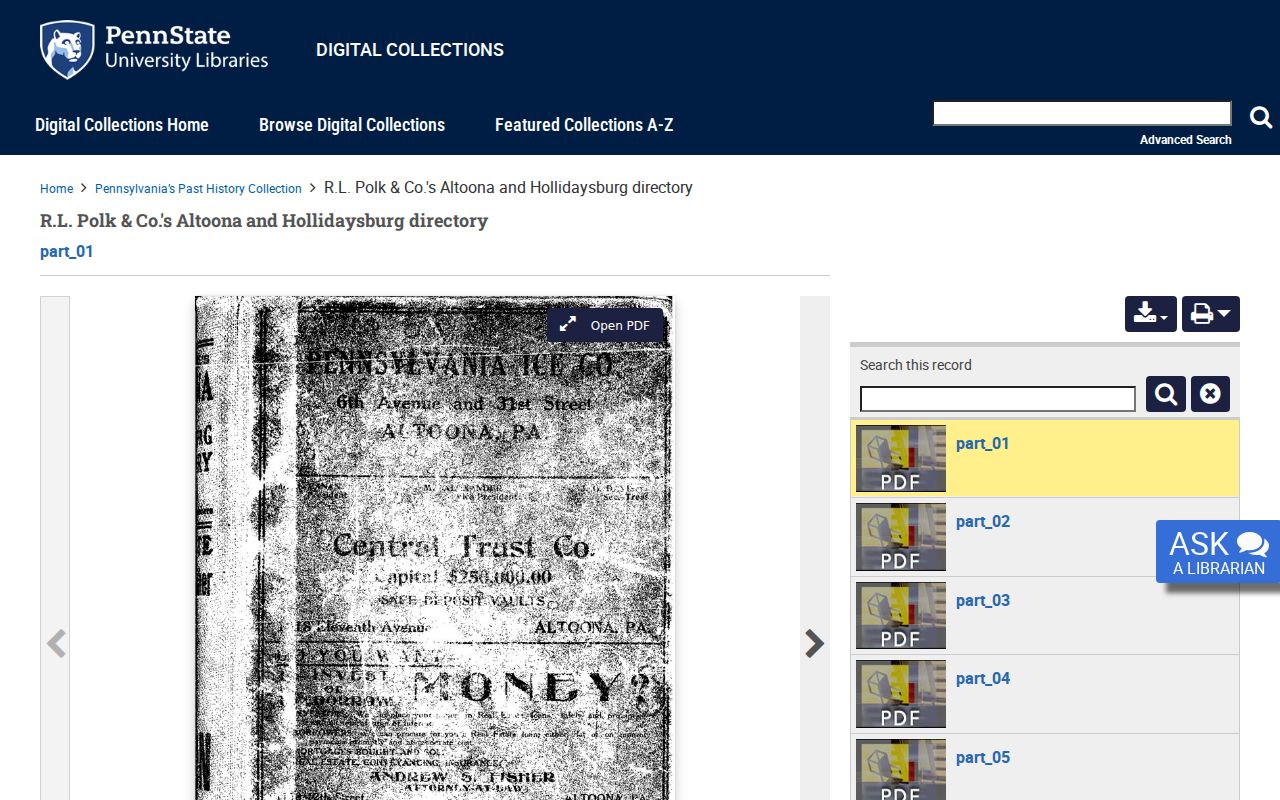
The volume includes Altoona and Hollidaysburg, as well as references such as Juniata and East End. Read those labels as the book prints them before equating an entry with a current municipal boundary.
In 1925, city history reported that 14,000 of 17,000 industrial workers in the area had a Pennsylvania Railroad connection. That local scale helps explain the compact rail and trade terms that can separate two same-name entries, but the printed occupation remains a date-specific clue.
Altoona City Directory Entry Marks
Read every part of an entry before searching another source. The Polk inspection documented surname, first name or initials, occupation or trade, employer or business detail in some entries, street address, and occasional spouse or widow relationship wording. A single line normally identifies the named directory subject. It does not claim to name every person in a household.
| Name | Surname with given name or initials, the starting point for nearby editions and census work. |
|---|---|
| Occupation or activity | A compact trade, role, or business detail that can distinguish people with the same name. |
| Address | The printed street location, useful as a dated lead rather than a present location. |
h / res | Residence notation in the inspected Polk volume. |
| Relationship wording | An occasional parenthetical widow relationship, such as a widow notation, can be a family-history lead. |
| Locality label | Juniata, East End, or another printed place reference that should remain attached to the citation. |
- Criss-cross directory
- A street-ordered directory section, useful only when the specific volume includes one.
- Householder index
- A section that organizes listings by household head, when a directory provides that arrangement.
- Abbreviation key
- A printed explanation of short marks, if present. Preserve the volume’s own key with any transcription.
Do not assume an old Altoona directory has a reverse or criss-cross section. The local holdings include old city directories, but no continuous reverse-directory run was verified.
Altoona Library Directory Routes
The Altoona Area Public Library is the local starting point when a desired edition is not on a digitized shelf. Its Digital Library brings together genealogy and local-history services, an Obituary Index, a Birth Index, historic photographs, newspaper access, and digitized resources. The library also has census microfilm for Blair and Huntingdon counties, a PA Room, Blair County Genealogical Society publications, family histories, and old city directories. It is at 1600 5th Avenue, Altoona, and can be reached at 814-946-0417.
The library’s Digitized Resources page identifies the local online collection routes.
Its listed resources include Blair County oral histories, historic photos, school-district history, the Altoona Tribune marriage and death indexes, and links to Sanborn Insurance Maps of Altoona. Those materials can corroborate a directory clue, but captions and oral histories need a record check.
For an in-person request, the library’s posted hours are Monday, Tuesday, and Thursday from 8:30 a.m. to 8 p.m.; Wednesday and Friday from 8:30 a.m. to 5 p.m.; Saturday from 9 a.m. to 4 p.m.; and Sunday closed. Ask whether the exact year has an address section before planning an address-first visit.
Altoona City Directory Census Pairing
A city directory is more useful when paired with a census schedule near the same period. Federal census records are household snapshots, not annual rolls. Released schedules reach through 1950 as of the research date, and the Altoona library provides a local microfilm route for Blair and Huntingdon counties. Compare names, age or birthplace clues, household composition, occupation, ward or neighborhood, and the printed address rather than relying on a name alone.
- Copy the directory entry exactly, including initials, occupation, residence mark, address, and locality label.
- Check one or two verified editions forward and backward. Record a change, but do not invent coverage for missing years.
- Use the closest released census year to test the household grouping and neighborhood context.
- Use the address with a period-appropriate map or parcel source when the place itself matters. The Altoona street directory handles the modern parcel and deed path.
- Close a possible trail with an obituary citation, estate index, marriage material, or a recorded deed when the source fits the question.
Disappearance from a directory has several ordinary explanations: a move, omission, variant spelling, residence outside the book’s coverage, or listing under another person. A census and a nearby edition are the first checks before treating it as a death or departure.
Altoona Newspaper Index Gaps
Newspapers help bridge the gaps between dated Altoona city directory volumes. The library’s Digitized Resources identifies the Altoona Tribune Marriage Index and Death Index for 1858 through 1872. Its wider Digital Library also links the Altoona Mirror, Newspaper Archive, and Pennsylvania Newspaper Archive, while the library’s obituary index supplies citation leads. An index points to a notice or issue; it is not automatically a certified vital record.
The Altoona Mirror is a continuing local newspaper title listed by the Library of Congress from 1888 to the present. A sound sequence is directory entry, newspaper index or citation, underlying notice, then estate, deed, or vital-record evidence when relevant. Each source should stay labeled as a printed notice, index, or official record.
Note: A citation-first newspaper index can narrow a date and surname, but the cited issue or official custodian remains the verification step.
Altoona Directory Local Geography
Historic directory geography does not match a modern map automatically. Altoona was a borough in 1854 and a city in 1868. Llyswen was a planned streetcar community from 1894 through 1907, and city history describes annexation-era growth that incorporated Juniata and other areas. The 1912–13 Polk book’s inclusion of Altoona and Hollidaysburg is another reason to preserve a locality name rather than silently rewriting it.
The City of Altoona history provides the rail-era and neighborhood context for these changing labels.
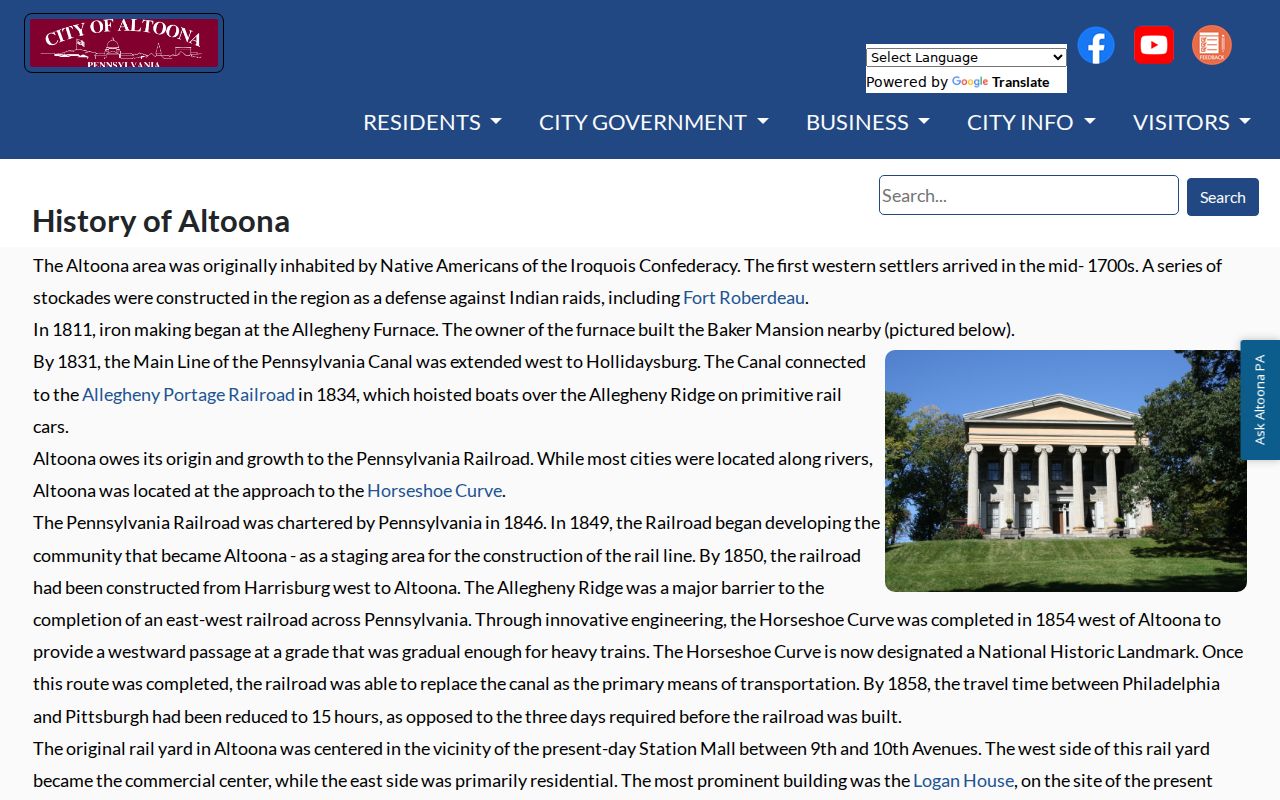
Use the locality, municipality, ward, and parcel district that fit the record date. That habit avoids turning an historic neighborhood reference into an unsupported present-city conclusion.
Altoona Directory Timeline
The documented chronology has useful landmarks, but it also has real blank spaces. Put the date of the volume beside the date of every other source used with it.
| 1849 | Altoona was laid out by the Pennsylvania Railroad. |
|---|---|
| 1870–71 | The HABS bibliography identifies Lant’s Blair County directory. |
| 1873–74 | Greevy’s Altoona city directory is a verified publisher-year pair. |
| 1896 | The cited R. L. Polk & Co. Altoona run begins. |
| 1912–13 | Penn State provides a digitized Polk Altoona and Hollidaysburg volume. |
| 1939 | The HABS bibliography cites a later Polk run, with gaps in the overall sequence. |
| 1950 | The latest released federal census year available during this research. |
Digitization is layered. Penn State makes one Polk volume inspectable, the library provides digital indexes and local access, and other years may require an archive or library inquiry. No continuous reverse or criss-cross collection was confirmed.
Altoona Directory Research Limits
City directories are historical printed sources. They may omit people, use initials, carry an old address, or cover nearby communities as well as Altoona. A listing is not a present address, and an occupation line is not a complete biography. The 1912–13 Polk book itself includes geographic labels beyond today’s city limits, so the volume’s scope belongs in every citation.
Use these records for lawful family history, local history, estate research, or a careful property timeline. Respect protected addresses and do not use directory or public-record information to stalk, harass, intimidate, or harm anyone.